Blog

Digital Spheres: Why 360-Degree Displays Are Transforming Visitor Engagement

Digital Spheres: Why 360-Degree Displays Are Transforming Visitor Engagement Organizations are constantly searching for new ways to capture attention, communicate information, and create memorable experiences. Although traditional displays remain effective in many environments, digital spheres offer something fundamentally different. Instead of presenting content on a flat surface, digital spheres allow information to be viewed from virtually every angle. As a result, digital spheres have become increasingly popular in museums, trade shows, visitor centers, corporate headquarters, educational institutions, and experiential marketing environments. Furthermore, their unique shape naturally attracts attention and encourages interaction. Because audiences see flat screens every day, businesses and organizations need display technologies that stand out immediately. Consequently, digital spheres have emerged as one of the most effective tools

Read More »

LED Display Power Consumption: Understanding Energy Usage and Efficiency

LED Display Power Consumption: What Businesses Need to Know Power consumption is a critical consideration when planning an LED display, especially for large installations, outdoor environments, retail spaces, museums, corporate lobbies, and public venues. Although LED displays are energy-efficient compared to many older display technologies, total power usage still depends on several important factors. As a result, businesses should understand how LED display power consumption works before selecting a system. With the right planning, organizations can reduce operating costs, avoid electrical issues, and ensure long-term display performance. Why LED Display Power Consumption Matters LED displays are often used for high-impact visual communication. However, larger displays require more power than smaller screens. Additionally, outdoor LED displays usually consume more electricity because

Read More »

Transparent OLED Display Applications for Retail, Museums, and Corporate Spaces

Transparent OLED Display Applications for Retail, Museums, and Corporate Spaces Transparent OLED Display: Blending Physical Products with Digital Storytelling A transparent OLED display represents one of the most visually striking display technologies available today. Unlike traditional displays that completely block the view behind them, transparent OLED screens allow viewers to see both digital content and physical objects at the same time. As a result, this technology creates an experience that feels futuristic, premium, and highly memorable. Furthermore, it opens new opportunities for retailers, museums, luxury brands, corporate environments, and experiential designers that want to deliver stronger customer engagement. As businesses continue searching for ways to stand out in competitive environments, transparent OLED technology is becoming one of the most sought-after

Read More »
Interactive Display Solutions by Screen Solutions International featuring LED walls, transparent OLED displays, touch kiosks, and digital spheres in a modern commercial space.
Uncategorized
Screen Solutions International

Interactive Display Solutions for Retail, Museums, Events, and Corporate Spaces

Interactive Display Solutions for Spaces That Need More Than a Screen Interactive Display Solutions are no longer just “nice-to-have” technology. For retail stores, museums, trade shows, corporate lobbies, entertainment venues, and public spaces, the right display can turn a normal environment into something people stop, notice, touch, share, and remember. At Screen Solutions International, we help businesses design custom visual display systems that go beyond traditional signage. From LED video walls and digital spheres to transparent OLED displays, touch kiosks, projection films, and projector enclosures, SSI builds display solutions for spaces where visual impact matters. Digital signage is becoming more interactive, connected, and experience-driven, with AVIXA describing digital signage as electronic visual communication that can include images, video, live data,

Read More »

Interactive Touch Kiosk Solutions for Retail, Museums, Healthcare, and Corporate Environments

Interactive Touch Kiosk Solutions for Retail, Museums, Healthcare, and Corporate Environments As customer expectations continue to evolve, organizations are increasingly investing in technologies that improve engagement, streamline operations, and provide self-service capabilities. Among the most effective solutions available today is the interactive touch kiosk. Not only do touch kiosks provide instant access to information, but they also help reduce staffing demands while delivering a more modern and engaging customer experience. As a result, touch kiosks have become a standard technology across numerous industries. What Is an Interactive Touch Kiosk? An interactive touch kiosk is a self-contained digital display equipped with touch-screen technology that allows users to interact directly with content. Unlike static signage, touch kiosks enable visitors to: Browse information

Read More »

LED Sphere Display Benefits for Events, Museums, and Experiential Marketing

LED Sphere Display Benefits for Events, Museums, and Experiential Marketing When it comes to creating unforgettable visual experiences, few technologies capture attention as effectively as an LED sphere display. Unlike traditional flat screens, digital spheres provide 360-degree visibility, allowing content to be viewed from every angle while creating a centerpiece that naturally draws crowds. As brands, museums, entertainment venues, and event organizers continue searching for innovative ways to engage audiences, LED sphere displays have emerged as one of the most powerful tools available. What Is an LED Sphere Display? An LED sphere display is a fully digital spherical screen constructed from specialized LED modules arranged to form a seamless globe. Content is mapped to the sphere using equirectangular media, creating

Read More »

LED Display Viewing Distance: How Far Is Too Far (or Too Close)?

One of the most common mistakes in LED display planning is ignoring viewing distance. Even the highest-quality LED display can look poor if the pixel pitch does not match how close viewers will be. Viewing distance determines how densely pixels need to be packed. If viewers are too close to a display with a large pixel pitch, individual LEDs become visible, creating a grainy image. If viewers are far away from a display with extremely fine pixel pitch, the added resolution provides no visible benefit and unnecessarily increases cost. A general rule of thumb is that optimal viewing distance (in feet) roughly equals pixel pitch (in millimeters) multiplied by three. While this isn’t a strict formula, it provides a useful

Read More »

LED Display Brightness Explained: Nits, Visibility, and Real-World Performance

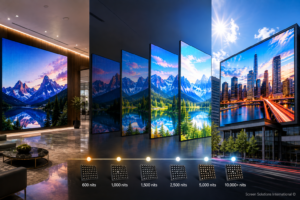
Brightness is one of the most important performance metrics for LED displays, yet it is often misunderstood. Measured in nits, brightness determines how well a display performs under ambient light — especially in outdoor or high-light environments. Indoor LED displays typically operate between 800 and 1,500 nits. This range delivers vivid visuals without causing glare or eye fatigue in controlled lighting conditions. Outdoor LED displays, however, may require 4,000 to 7,000+ nits to remain visible in direct sunlight. Choosing excessive brightness for indoor applications wastes energy and can reduce visual comfort. Choosing insufficient brightness outdoors leads to washed-out content and poor readability. Brightness also impacts power consumption and thermal performance. Higher brightness requires more energy and generates more heat, making

Read More »