
Showing the single result
LED Display Color Temperature Explained: Choosing the Right White Balance for Commercial LED Video Walls
Introduction
Two LED video walls can have the same pixel pitch, resolution, brightness, and size yet produce noticeably different images.
One reason is LED display color temperature.
Color temperature controls whether white light appears warmer, more neutral, or cooler. Consequently, it affects nearly every color viewers see on an LED display.
A display with a warmer white point can make an environment feel inviting and natural. Meanwhile, a cooler white point may create a crisp, high-energy appearance. However, if the color temperature doesn’t match the space, content, or cameras, even an expensive LED wall can look unnatural.
This specification becomes particularly important in corporate lobbies, broadcast studios, museums, retail stores, trade shows, control rooms, hospitality environments, and experiential installations.
Furthermore, color temperature doesn’t exist in isolation. Ambient lighting, content production, camera settings, grayscale, brightness, calibration, and LED quality all influence the final result.
At Screen Solutions International (SSI), we approach color temperature as part of the complete display system. Rather than simply choosing a factory default, we help clients configure LED displays around the actual environment and application.
In this guide, we’ll explain color temperature, common Kelvin values, why white balance matters, and how commercial buyers can choose the right setting for their LED video wall.
What Is LED Display Color Temperature?
Color temperature describes the appearance of white light.
It is measured in Kelvin (K).
Although the terminology can seem backward at first, lower Kelvin values appear warmer, while higher Kelvin values appear cooler.
For example:
| Color Temperature | General Appearance | Typical Use |
|---|---|---|
| 3,200K | Warm white | Studios, warm architectural spaces |
| 4,000K | Neutral-warm | Hospitality, retail |
| 5,000K | Neutral daylight | Commercial interiors |
| 5,600K | Daylight / production | Broadcast, events |
| 6,500K | Cool daylight | Common display reference point |
| 7,500K+ | Cooler blue-white | Specialized high-impact applications |
These aren’t rigid rules. Instead, they provide useful starting points.
The ideal setting depends on your environment, content, lighting, and business goals.
Why Does Color Temperature Matter?
White serves as a reference point for virtually every color on a display.
Therefore, when white balance changes, the overall image changes as well.
If color temperature is too cool, viewers may notice:
- Bluish whites
- Cooler skin tones
- Unnatural product colors
- A harsher appearance
Conversely, an overly warm setting may create:
- Yellowish whites
- Warm skin tones
- Reduced visual neutrality
- Incorrect brand colors
Therefore, proper color temperature helps content appear closer to its intended appearance.
For commercial buyers, that directly supports brand consistency and customer experience.
What Does Kelvin Mean?
Kelvin provides a standardized way to describe the visual appearance of light.
For LED displays, a lower Kelvin value generally shifts white toward warmer red and yellow tones.
Meanwhile, higher values shift white toward cooler blue tones.
Consider a familiar example.
A warm restaurant may use lighting around 2,700K to 3,000K. Consequently, the environment feels soft and inviting.
Natural daylight, however, can appear considerably cooler.
An LED wall installed inside either environment should account for the surrounding lighting.
Otherwise, the screen may appear disconnected from the architecture around it.
3,200K vs. 5,600K vs. 6,500K
These three values frequently appear in professional video and display environments.
3,200K
3,200K produces a noticeably warmer white.
It has traditionally been associated with tungsten-style studio lighting. Additionally, it can work well in spaces with warm architectural lighting.
However, it may make content look too warm in daylight-oriented environments.
5,600K
5,600K approximates a common daylight reference used in production environments.
Therefore, it can work particularly well when cameras and studio lighting use similar settings.
6,500K
6,500K, often associated with the D65 reference white used in imaging standards, is common in professional display calibration.
It produces a cooler daylight-style white than 5,600K.
However, the correct choice still depends on the application.
Color Temperature for Corporate Lobby LED Walls
Corporate lobbies often combine several types of lighting.
These may include:
- Natural daylight
- Recessed architectural lighting
- Decorative fixtures
- Accent lighting
- Large windows
Consequently, the LED display must visually coexist with multiple light sources.
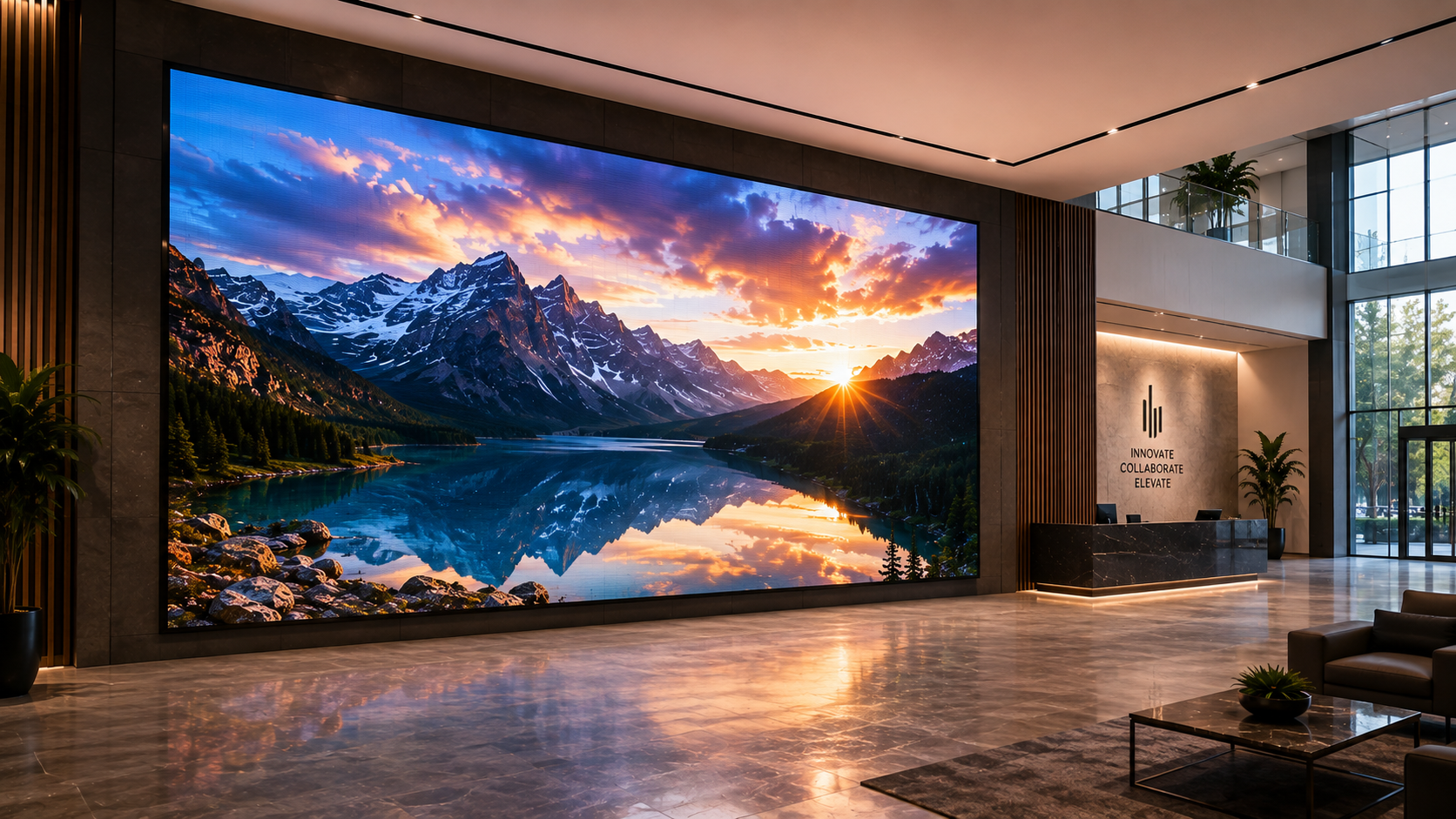
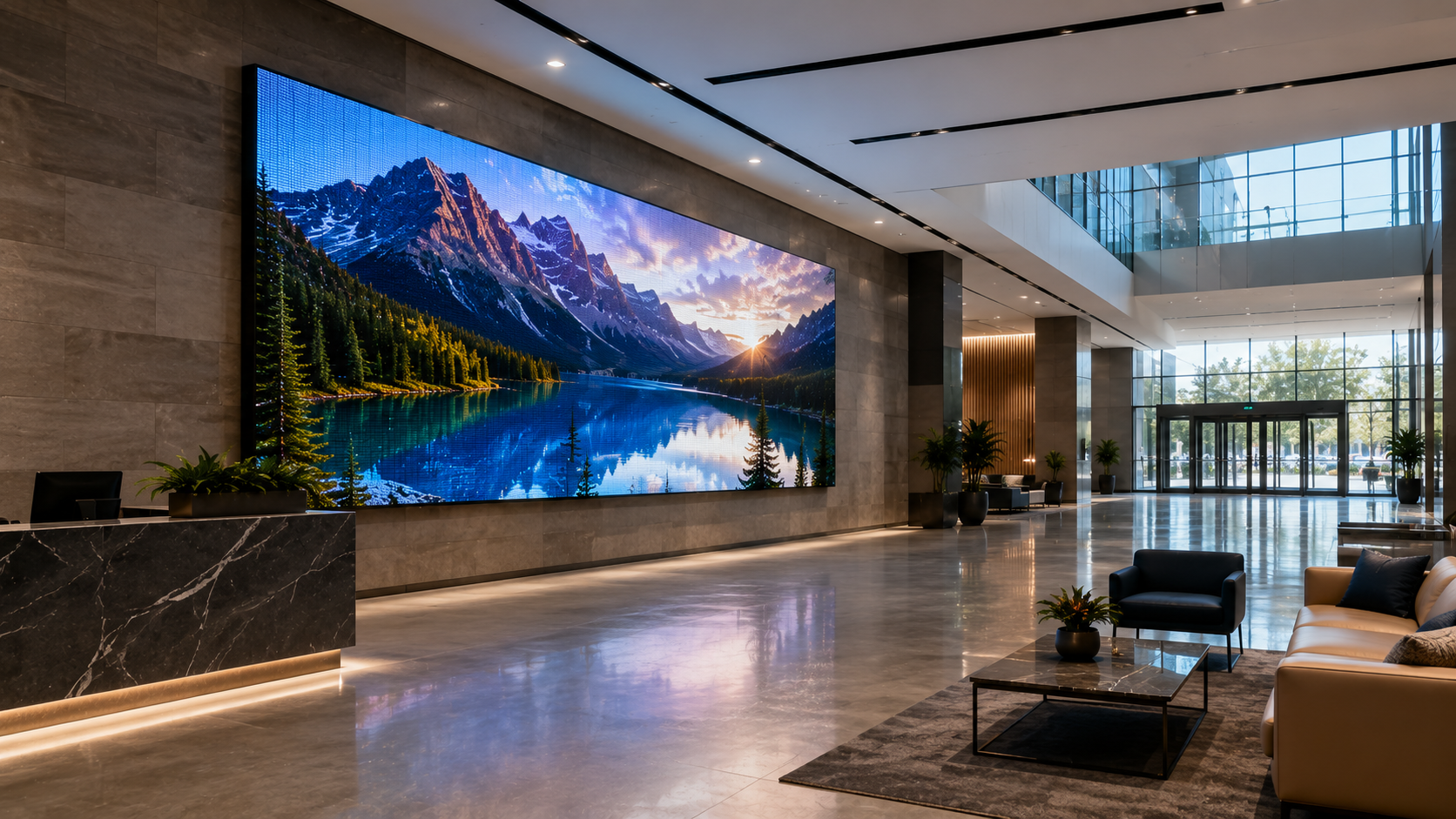
Imagine a luxury corporate lobby with warm wood finishes and 3,500K architectural lighting.
If the LED wall operates at an extremely cool white point, the display may look disconnected from the environment.
Conversely, a carefully calibrated white balance can make the LED installation feel integrated into the architecture.
This becomes particularly important when businesses use LED walls for:
- Brand films
- Executive messaging
- Product photography
- Global company data
- Digital artwork
- Corporate storytelling
Therefore, lobby LED design should consider the surrounding architecture—not just the display specifications.
Internal SSI Link:
https://ssidisplays.com/ultimate-guide-led-video-walls-2/
Color Temperature for Retail Displays
Retail environments require particularly careful color reproduction.
Customers use displays to evaluate:
- Clothing
- Cosmetics
- Jewelry
- Furniture
- Electronics
- Automobiles
- Food
- Luxury goods
Consequently, incorrect white balance can affect product appearance.
For example, a clothing brand may carefully photograph a product using controlled studio lighting.
However, if the retail LED wall uses an incorrect color temperature, the displayed fabric may appear different from the physical product nearby.
That inconsistency can weaken the customer experience.
Therefore, retailers should consider both color temperature and overall color calibration when selecting LED technology.
Color Temperature for Museums
Museums often control environmental lighting carefully.
Therefore, LED displays need to integrate with exhibit lighting rather than overpower it.
Museums may use LED displays for:
- Historical photography
- Fine art
- Scientific visualization
- Archival video
- Maps
- Interactive exhibits
In these applications, visual accuracy can matter significantly.
For example, a historical photograph shouldn’t suddenly appear excessively blue because the display uses an inappropriate white point.
Instead, proper calibration helps preserve the intended visual character.
Color Temperature for Broadcast Studios
Broadcast environments require even greater precision.
The camera sees color differently than the human eye.
Therefore, LED walls must coordinate with:
- Studio lighting
- Camera white balance
- Video processors
- Content
- Color-management systems
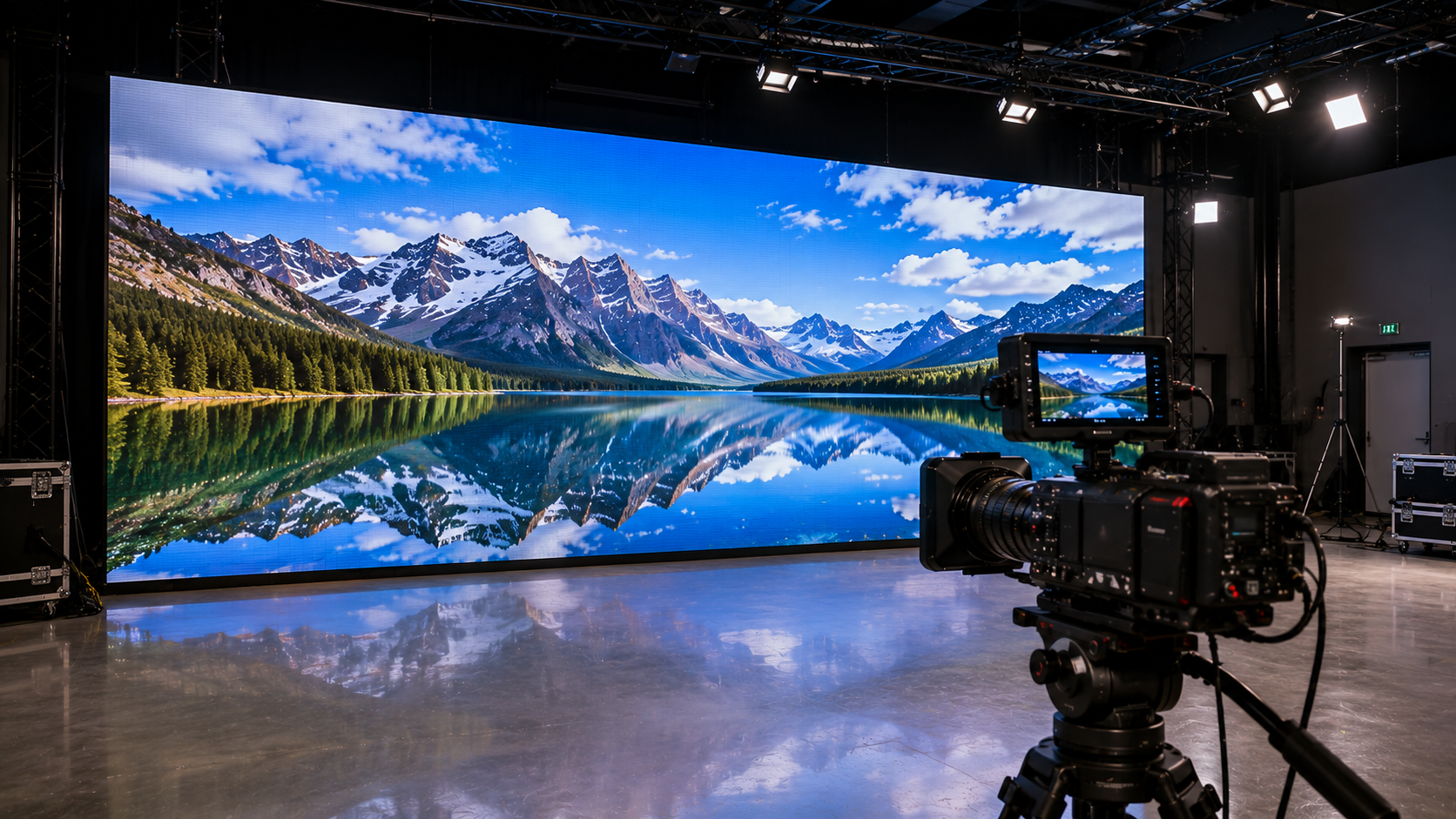
If the LED wall and cameras don’t align properly, the display may appear incorrect on television even though it looks acceptable in person.
Consequently, production teams often use controlled reference values.
Common environments may use approximately:
- 3,200K for warmer studio lighting
- 5,600K for daylight-oriented production
However, modern production workflows vary widely.
Therefore, testing and calibration remain essential.
Color Temperature for Trade Show LED Walls
Trade show halls present challenging lighting conditions.
Overhead lighting may differ dramatically between convention centers. Meanwhile, neighboring booths add additional light sources.
Furthermore, exhibitors increasingly record:
- Interviews
- Product demonstrations
- Social media videos
- Livestreams
- Event recaps
Therefore, trade show LED walls need to look good both to visitors and cameras.
A properly calibrated color temperature can help:
- Maintain natural skin tones
- Improve product colors
- Match booth lighting
- Produce better photographs
- Create better marketing video
As a result, calibration can increase the value of the LED installation beyond the event itself.
Color Temperature and Cameras
Camera compatibility deserves special attention.
Suppose a camera is white-balanced for approximately 5,600K lighting while an LED wall uses a significantly different white point.
The camera may render the LED wall differently than expected.
As a result, recorded footage may show:
- Blue shifts
- Yellow shifts
- Unnatural whites
- Incorrect skin tones
- Brand color differences
Therefore, camera-facing LED installations should be evaluated as complete production environments.
Additionally, refresh rate and scan rate matter.
Internal SSI Link:
https://ssidisplays.com/led-display-scan-rate/
For professional production applications, color temperature, refresh rate, scan architecture, processing, and camera settings all need to work together.
Color Temperature and Brightness
Brightness can change how viewers perceive color.
At extremely high brightness, cool whites can appear particularly intense.
Conversely, lower brightness levels may make warmer tones feel more comfortable.
Therefore, brightness and color temperature should be adjusted together.
This becomes particularly important for indoor displays.
An LED wall capable of 1,500 nits may only need to operate at a fraction of maximum brightness in a controlled corporate environment.
Consequently, calibration should occur at realistic operating brightness—not simply at maximum output.
Color Temperature and Grayscale
Grayscale describes how accurately a display reproduces tonal steps between dark and bright output.
Meanwhile, color temperature establishes the white point.
Both affect overall image quality.
For example, a display may achieve the correct 6,500K white point at full brightness but shift color as brightness decreases.
Premium LED systems should maintain strong color consistency across multiple brightness levels.
Therefore, businesses should evaluate:
- Full-brightness color
- Low-brightness color
- Grayscale
- White balance
- Shadow detail
This becomes especially important for museums, broadcast, luxury retail, and premium corporate installations.
Color Temperature and Contrast
Contrast affects the difference between bright and dark portions of the image.
Meanwhile, color temperature affects the appearance of those bright areas and overall color balance.
Therefore, both specifications contribute to perceived image quality.
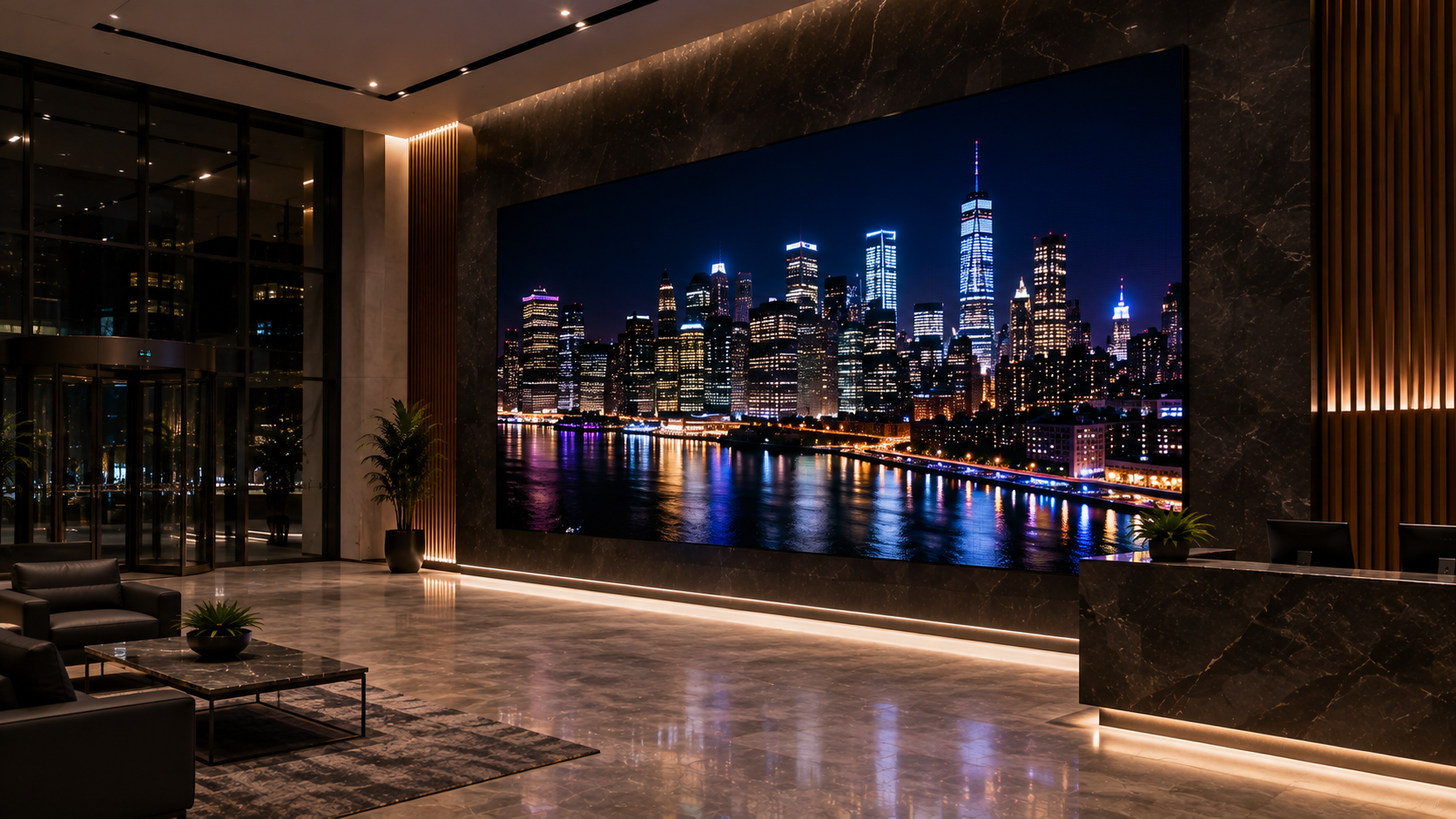
For example, a nighttime city scene needs deep blacks for strong contrast.
However, the illuminated buildings also need an appropriate white balance.
If those highlights become excessively blue, the image may still look unnatural despite excellent contrast.
Consequently, premium LED image quality depends on multiple specifications working together.
Matching the LED Wall to Architectural Lighting
This step is often overlooked.
A commercial LED wall doesn’t operate in a laboratory.
It operates inside architecture.
Therefore, consider the color temperature of:
- Ceiling fixtures
- Accent lights
- Wall washers
- Decorative lighting
- Daylight
- Nearby digital displays
If the architecture uses warm lighting, an extremely cool LED wall may visually dominate the room.
However, if the space uses modern daylight-balanced lighting, a warmer LED wall may look yellow.
Therefore, SSI evaluates the entire environment when appropriate.
Color Temperature and Brand Colors
Businesses invest heavily in brand standards.
Corporate identity guidelines often specify exact colors.
Therefore, the LED wall should reproduce those colors as accurately as practical.
However, incorrect white balance can shift perceived color.
This becomes especially important for companies with distinctive:
- Reds
- Blues
- Greens
- Oranges
- Neutral tones
A logo that looks correct on a designer’s calibrated monitor shouldn’t appear dramatically different on a 20-foot LED wall.
Consequently, professional calibration can protect brand consistency.
Does Higher Kelvin Mean a Better LED Display?
No.
Higher Kelvin doesn’t mean higher quality.
Likewise, lower Kelvin doesn’t mean lower quality.
Color temperature is a setting or performance characteristic—not a quality ranking.
A premium LED display should allow the system to be calibrated appropriately for the application.
Therefore, buyers should focus on:
- Adjustable color temperature
- Calibration quality
- Color consistency
- Grayscale performance
- Processing
- LED quality
The ability to produce the right white point matters more than producing the coolest possible white.
Comparing Common Commercial Applications
| Application | Typical Starting Range | Primary Consideration |
|---|---|---|
| Corporate Lobby | 4,500–6,500K | Architectural integration |
| Retail | 4,000–6,500K | Product color |
| Museum | Application dependent | Content accuracy |
| Trade Show | 5,000–6,500K | Booth lighting and cameras |
| Broadcast | Often 3,200K or 5,600K workflows | Camera matching |
| Control Room | Around calibrated display standards | Visual consistency |
| Outdoor LED | Often cooler daylight settings | Daytime visibility |
These values should not be treated as universal specifications.
Instead, they provide starting points for project planning.
Business Benefits of Proper Color Calibration
Color temperature may appear highly technical. However, proper calibration creates real business value.
Better Brand Consistency
Corporate colors appear more accurate.
Improved Product Presentation
Customers see more realistic product imagery.
Better Customer Experience
Displays feel integrated with the environment.
Better Camera Performance
Proper white balance can produce more professional video and photography.
Greater Perceived Quality
Natural color reproduction makes the entire LED installation feel more premium.
Consequently, calibration helps businesses extract more value from their hardware investment.
Common Mistakes With LED Color Temperature
Leaving the Display at Factory Defaults
Factory settings may not match your environment.
Therefore, calibrate the display for its actual installation.
Choosing the Coolest White
Cooler doesn’t automatically mean brighter or better.
Instead, match the application.
Ignoring Architectural Lighting
The LED wall needs to coexist with surrounding light sources.
Forgetting About Cameras
Camera-facing LED walls require additional consideration.
Evaluating Color Only at Maximum Brightness
Color behavior can change when brightness decreases.
Therefore, test realistic operating levels.
Ignoring Content
Your content pipeline also needs appropriate color management.
Even an excellent LED wall cannot fully correct poorly prepared source material.
Future Trends in LED Color Management
LED display color performance continues advancing.
Improved Calibration
Automated calibration systems continue becoming more accurate.
AI-Assisted Optimization
AI systems may increasingly monitor and correct display performance automatically.
HDR
High Dynamic Range content requires greater control over color and brightness.
Wider Color Gamuts
Premium LED systems continue improving the range of colors they can reproduce.
Broadcast and Virtual Production
Growing use of LED walls in production will continue pushing manufacturers toward more sophisticated color-management systems.
Consequently, color accuracy will become increasingly important across commercial LED applications.
Why Choose Screen Solutions International
A commercial LED display needs to perform in your actual environment—not simply in a manufacturer’s showroom.
Screen Solutions International evaluates:
- Color temperature
- Pixel pitch
- Viewing distance
- Brightness
- Contrast
- Grayscale
- Refresh rate
- Scan rate
- Content
- Ambient lighting
- Camera requirements
- Installation conditions
SSI provides:
- Fine-Pitch LED Video Walls
- COB LED Displays
- SMD LED Displays
- Corporate Lobby Displays
- Trade Show LED Displays
- High Bright Displays
- LED Floors
- Digital Spheres
- Interactive Displays
- Transparent OLED Displays
- Custom Experiential Displays
Most importantly, we help clients match the display to the application.
Whether you’re designing a corporate headquarters, retail experience, museum exhibit, broadcast studio, trade show booth, or immersive installation, SSI can help engineer a display system around your business objectives.
Contact Screen Solutions International at 888-631-5880 to discuss your project.
Frequently Asked Questions
What is LED display color temperature?
LED display color temperature describes whether white appears warmer or cooler. It is measured in Kelvin (K).
Is 6,500K a good LED display color temperature?
6,500K is a common reference white for professional displays. However, the ideal setting depends on the environment, content, lighting, and application.
Is 5,600K better for cameras?
5,600K is a common daylight-oriented reference in video production. However, camera white balance, lighting, and the entire production workflow should be coordinated.
Does color temperature affect brand colors?
Yes. An incorrect white point can influence the perceived appearance of other colors.
Can LED color temperature be adjusted?
Professional commercial LED systems generally provide color adjustment through the display processing and calibration system.
Should an LED wall match room lighting?
Not necessarily exactly. However, the LED wall should visually complement the surrounding lighting and intended viewing experience.
Final Takeaway
LED display color temperature has a significant effect on how viewers perceive white, color, products, people, and branded content.
However, there is no single Kelvin setting that’s correct for every installation.
A corporate lobby, museum, retail store, trade show booth, and broadcast studio can all require different approaches.
Therefore, the best strategy is to evaluate color temperature alongside ambient lighting, brightness, grayscale, contrast, processing, content, and camera requirements.
Most importantly, don’t assume factory settings provide the best result.
Proper calibration can transform an LED wall from a large bright screen into a visual system that feels naturally integrated with the surrounding environment.
Screen Solutions International can help specify, engineer, and calibrate commercial LED solutions around your actual application.
Contact 888-631-5880 to discuss your next LED display project.
Sources
Internal SSI Links
- https://ssidisplays.com/
- https://ssidisplays.com/ultimate-guide-led-video-walls-2/
- https://ssidisplays.com/cob-vs-smd-led-displays/
- https://ssidisplays.com/how-to-choose-the-right-led-display-for-your-business/
- https://ssidisplays.com/led-display-types-explained/
- https://ssidisplays.com/led-display-scan-rate/
External Authority Sources
Latest Post