
Introduction
When businesses compare LED video walls, specifications such as pixel pitch, brightness, contrast, and refresh rate usually receive most of the attention. However, another technical factor can directly affect image quality and camera performance: LED display scan rate.
Scan rate describes how an LED module drives groups of pixels during operation. Although buyers may never adjust this setting themselves, the scan architecture can influence brightness, grayscale performance, refresh behavior, power requirements, and how the display appears on camera.
Therefore, scan rate becomes especially important for premium commercial environments.
Corporate lobbies need clean, professional images. Broadcast studios need camera-friendly performance. Trade show displays need to look excellent both in person and in videos. Control rooms need fine detail. Meanwhile, virtual production environments demand exceptionally stable performance.
At Screen Solutions International (SSI), we evaluate these specifications as part of the complete LED system. Rather than choosing a display based on one impressive number, we consider how the LED modules, driver ICs, processor, pixel pitch, brightness, refresh rate, scan architecture, and content work together.
In this guide, we’ll explain LED display scan rate in straightforward business language, show why it matters, and help you understand what to look for when purchasing a commercial LED display.
What Is LED Display Scan Rate?
An LED display contains thousands—or even millions—of individual LEDs.
However, the electronics don’t necessarily drive every LED continuously and independently at the same moment.
Instead, many LED modules use multiplexed scanning. The driver electronics activate different rows or groups of LEDs extremely quickly.
The human eye combines those rapid cycles into what appears to be one continuous image.
Common scan configurations may include:
- 1/2 scan
- 1/4 scan
- 1/8 scan
- 1/16 scan
- 1/32 scan
- 1/64 scan
For example, a 1/16 scan configuration means the driver architecture cycles through groups corresponding to the module’s scanning design rather than powering every row continuously at once.
However, the practical performance depends on far more than the scan fraction alone.
Driver IC quality, module architecture, refresh settings, brightness, grayscale processing, and calibration all influence the final image.
Therefore, commercial buyers should avoid assuming that one scan rate automatically guarantees better quality.
Static Drive vs. Scanning
A helpful way to understand scan rate is to compare static drive with multiplexed scanning.
With static drive, each LED or pixel-driving circuit receives more continuous control.
Conversely, multiplexed systems rapidly cycle through groups of LEDs.
Static-drive configurations can provide performance advantages for certain specialized applications. However, they generally require more driver circuitry.
Multiplexed scanning helps manufacturers balance:
- Component count
- Power requirements
- Heat
- Module design
- Pixel density
- Cost
Consequently, scanning has become an important part of LED display engineering.
For buyers, though, the most important question remains:
Does the complete display deliver the visual performance your application requires?
Why Does LED Scan Rate Matter?
Scan architecture can influence several display characteristics.
These may include:
- Brightness
- Refresh performance
- Grayscale
- Camera compatibility
- Power consumption
- Heat
- Image stability
However, these factors interact with one another.
Therefore, you shouldn’t compare two displays solely by reading “1/16 scan” or “1/32 scan” on a specification sheet.
Instead, evaluate the actual display system.
For high-value installations, ask how the proposed configuration performs under the conditions your organization will use every day.
LED Scan Rate vs. Refresh Rate
Scan rate and refresh rate are related concepts, but they aren’t interchangeable.
Scan Rate
Additionally, Scan rate relates to how the LED driver architecture activates groups of pixels.
Refresh Rate
Refresh rate relates to how frequently the display refreshes the image output.
A commercial LED display might offer a refresh specification of:
- 1,920 Hz
- 3,840 Hz
- 7,680 Hz or higher
However, that refresh specification doesn’t tell you the complete scan architecture.
Likewise, knowing the scan configuration doesn’t automatically tell you the effective camera performance.
Therefore, both specifications need to be considered as part of the full display design.
If you’re comparing camera-facing LED systems, also review SSI’s guide to LED Display Refresh Rate.
Why Scan Architecture Can Affect Brightness
In a multiplexed LED module, individual groups of LEDs turn on and off rapidly.
Therefore, the amount of time each LED remains active during the scanning cycle can influence perceived brightness.
Manufacturers compensate through several methods, including:
- Driver current
- LED efficiency
- Module design
- Power architecture
- Scan timing
Consequently, two displays with similar scan rates may still have significantly different brightness capabilities.
This becomes especially important when comparing indoor and outdoor LED systems.
An indoor corporate display may only require moderate brightness.
Meanwhile, an outdoor display may need thousands of nits to remain visible in sunlight.
Therefore, scan rate should always be considered alongside actual brightness requirements.
Why Scan Rate Matters for Cameras
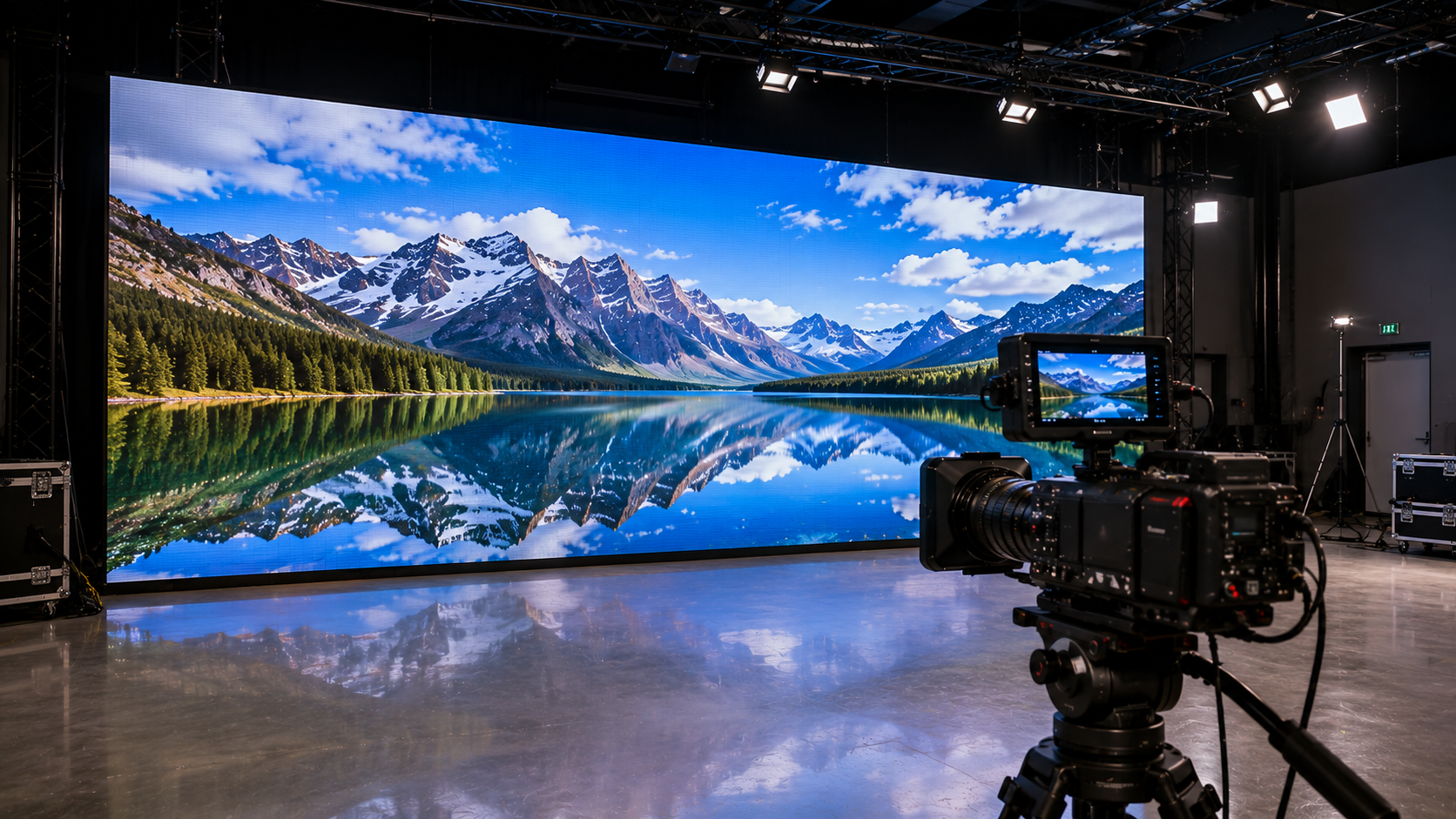
Cameras can reveal LED behavior that the human eye doesn’t notice.
A person standing in front of an LED video wall may see a perfectly stable image.
However, a camera can potentially capture:
- Dark horizontal bands
- Flickering
- Brightness variations
- Scan lines
- Unstable patterns
Several factors can contribute to these artifacts.
These include:
- Scan architecture
- Refresh rate
- Camera shutter speed
- Frame rate
- Driver IC performance
- Processor configuration
Consequently, camera-facing applications require careful system specification.
LED Scan Rate for Trade Shows
Trade show booths provide a perfect example.
A modern LED wall isn’t viewed only by people walking through the exhibit hall.
Attendees constantly record it with smartphones.
Meanwhile, marketing teams film interviews and demonstrations.
Additionally, exhibitors create social media content throughout the event.
Therefore, the display must perform in two environments simultaneously:
In person and on camera.
A poorly specified LED system might look acceptable to visitors but create visible bands in recorded footage.
That reduces the value of the installation.
Conversely, a properly engineered system can generate impressive visual content that continues delivering marketing value long after the event ends.
Internal SSI Link:
https://ssidisplays.com/ultimate-guide-led-video-walls-2/
LED Scan Rate for Corporate Lobbies
Corporate lobby displays increasingly serve as major architectural features.
Businesses use them for:
- Brand storytelling
- Welcome messaging
- Product launches
- Global company information
- Digital artwork
- Live data
- Corporate videos
Additionally, visitors frequently photograph these installations.
Therefore, camera performance can matter even when the lobby wasn’t designed as a production studio.
A premium LED display should look polished to visitors while also producing clean results in corporate photography and video.
Consequently, scan architecture, refresh rate, grayscale, and processing deserve consideration during system design.
LED Scan Rate for Broadcast Studios
Broadcast environments place significantly greater demands on LED technology.
Here, the LED wall may remain visible on camera for hours.
Therefore, engineers need to carefully coordinate:
- LED scan architecture
- Refresh rate
- Camera shutter
- Frame rate
- Color processing
- Brightness
- Grayscale
- Synchronization
In these applications, simply choosing a “high refresh rate” LED display may not be enough.
Instead, the entire signal chain should support the production environment.
For mission-critical broadcast installations, testing the proposed LED system with the intended camera equipment can provide valuable information before deployment.
Scan Rate for Virtual Production
Virtual production pushes LED technology even further.
Large LED walls replace or supplement traditional green-screen environments.
As a result, the camera directly captures the LED background.
Therefore, visible artifacts can immediately affect production quality.
Virtual production systems may require precise coordination between:
- LED processors
- Camera systems
- Rendering engines
- Tracking systems
- Synchronization equipment
- LED modules
Consequently, these projects require specialized engineering rather than standard digital-signage specifications.
Scan Rate and Fine-Pitch LED
As pixel pitches become smaller, module design becomes increasingly sophisticated.
Fine-pitch displays may use:
- P0.9
- P1.2
- P1.5
- P1.8
- P1.9
These products pack enormous numbers of pixels into relatively small areas.
Therefore, manufacturers must balance pixel density with driver architecture, heat management, power consumption, and image quality.
This makes the relationship between scan design and driver electronics increasingly important.
For close-viewing environments, buyers should evaluate the complete visual result rather than assuming that smaller pixel pitch alone guarantees superior performance.
Internal SSI Link:
https://ssidisplays.com/how-to-choose-the-right-led-display-for-your-business/
Scan Rate and COB LED Displays
COB, or Chip-on-Board LED, continues gaining attention for premium fine-pitch applications.
COB technology can provide advantages such as:
- Very fine pixel pitches
- Durable display surfaces
- Excellent close-viewing performance
- Improved resistance to physical contact
- Strong contrast potential
However, COB describes the LED packaging and manufacturing approach. It doesn’t eliminate the need for high-quality driver electronics and processing.
Therefore, COB displays should still be evaluated for:
- Refresh rate
- Scan architecture
- Grayscale
- Contrast
- Brightness
- Calibration
Internal SSI Link:
https://ssidisplays.com/cob-vs-smd-led-displays/
Scan Rate and Grayscale
Grayscale describes how precisely an LED display reproduces brightness levels.
Strong grayscale creates smoother:
- Shadows
- Gradients
- Color transitions
- Dark scenes
- Photography
However, grayscale performance can interact with brightness settings, driver IC behavior, scan configuration, and processing.
Consequently, a display that looks impressive at maximum brightness may behave differently when dimmed.
This becomes particularly important for:
- Museums
- Broadcast studios
- Corporate boardrooms
- Luxury retail
- Control rooms
Therefore, buyers should evaluate the display at realistic operating brightness levels.
Scan Rate and Power Consumption
Power efficiency remains important for large commercial LED systems.
A massive LED wall can contain millions of individual light-emitting elements.
Therefore, even relatively small improvements in system efficiency can affect long-term operating costs.
Scan architecture contributes to the overall electrical design.
However, total power consumption also depends on:
- Brightness
- Content
- LED efficiency
- Power supplies
- Cabinet design
- Operating hours
Consequently, ask for realistic average power consumption, not simply maximum power figures.
This information provides a better basis for estimating operating costs.
Does a Lower Scan Fraction Mean a Better Display?
Not automatically.
This is an important distinction.
A specification such as 1/8 scan may appear better than 1/32 scan when viewed in isolation.
However, that doesn’t guarantee superior real-world image quality.
Modern driver ICs and module architectures can produce excellent results across different scanning configurations.
Therefore, compare:
- Image quality
- Refresh rate
- Grayscale
- Brightness
- Camera performance
- Power consumption
- Reliability
- Calibration
- Serviceability
The complete system matters more than one scan number.
LED Scan Rate by Commercial Application
| Application | Scan Performance Importance | Other Major Factors |
|---|---|---|
| Corporate Lobby | Medium-High | Contrast, pixel pitch, camera use |
| Boardroom | High | Fine detail, grayscale, resolution |
| Retail | Medium | Brightness, contrast, color |
| Trade Show | High | Cameras, refresh rate, modularity |
| Broadcast Studio | Very High | Synchronization, camera performance |
| Virtual Production | Critical | Processing, synchronization, color |
| Control Room | High | Detail, reliability, uptime |
| Outdoor Advertising | Moderate | Brightness, weather resistance |
Therefore, the application should determine how much attention scan performance receives during system specification.
Business Value: Why Buyers Should Care
Scan rate sounds like an engineering specification.
However, technical performance affects business outcomes.
Better Marketing Content
Camera-friendly displays create more usable photographs and videos.
Stronger Brand Presentation
Stable, premium images reinforce professionalism.
Fewer Technical Problems
Proper system design reduces troubleshooting during events and presentations.
Better Long-Term ROI
Selecting the correct display initially can reduce the likelihood of expensive upgrades later.
Greater Flexibility
A properly specified system may support future video production or broadcast requirements.
Therefore, understanding the intended application before purchasing provides significant value.
Common Mistakes When Evaluating LED Scan Rate
Comparing Scan Rate Alone
Scan architecture is only one part of the display system.
Instead, evaluate total image performance.
Confusing Scan Rate With Refresh Rate
They’re related but different specifications.
Therefore, review both.
Ignoring Cameras
If the display will appear in photographs or video, tell your integrator before selecting hardware.
Evaluating Only Maximum Brightness
Indoor displays rarely need to operate continuously at maximum brightness.
Therefore, test realistic settings.
Buying From Specification Sheets Alone
Two displays with similar specifications can produce noticeably different results.
Whenever possible, evaluate actual samples or application-specific demonstrations.
Future Trends in LED Scanning Technology
LED driver technology continues advancing.
More Advanced Driver ICs
Newer drivers can improve efficiency, grayscale, and image stability.
Better Camera Compatibility
Broadcast and virtual production continue driving development in camera-friendly LED systems.
Higher Pixel Density
Fine-pitch LED increases demand for increasingly sophisticated module architecture.
Improved Energy Efficiency
Manufacturers continue improving output while reducing power requirements.
Smarter Calibration
Automated calibration systems will increasingly optimize display performance in real time.
As a result, scan architecture will continue evolving alongside the broader commercial LED industry.
Why Choose Screen Solutions International
Commercial LED systems require more than a visually impressive specification sheet.
Screen Solutions International evaluates the complete application.
We consider:
- Pixel pitch
- Viewing distance
- Scan architecture
- Refresh rate
- Grayscale
- Contrast
- Brightness
- Camera use
- Content
- Environment
- Processing
- Future requirements
SSI provides:
- Fine-Pitch LED Video Walls
- COB LED Displays
- SMD LED Displays
- Corporate Lobby Displays
- Trade Show LED Displays
- High Bright Displays
- LED Floors
- Digital Spheres
- Interactive Displays
- Transparent OLED Displays
- Custom Experiential Displays
Our goal is to match the technology to your actual business requirements rather than overspecifying or underspecifying the system.
For help designing your next commercial LED installation, contact Screen Solutions International at 888-631-5880.
Frequently Asked Questions
What is LED display scan rate?
LED display scan rate describes how the driver electronics cycle through groups of LEDs within a module.
What does 1/16 scan mean?
It describes the multiplexing architecture used to drive groups of LEDs. However, the scan fraction alone doesn’t determine overall display quality.
Is scan rate the same as refresh rate?
No. Scan rate relates to LED driving architecture, while refresh rate relates to how frequently the display refreshes its output.
Does scan rate affect cameras?
It can. Scan architecture, refresh rate, camera shutter settings, processing, and driver technology can all influence camera performance.
What scan rate is best for LED displays?
There isn’t one universally best scan rate. The appropriate architecture depends on the module design, pixel pitch, application, brightness requirements, and other system characteristics.
Should trade show buyers care about scan rate?
Yes, particularly because trade show LED walls are frequently photographed and filmed.
Final Takeaway
LED display scan rate is an important technical specification, particularly for high-performance commercial applications.
However, it shouldn’t be evaluated in isolation.
Scan architecture works alongside refresh rate, grayscale, brightness, pixel pitch, driver technology, processing, and calibration. Consequently, the best commercial LED system is the one that balances these factors around the actual application.
For a basic signage installation, scan architecture may remain largely invisible to the end user.
Conversely, broadcast studios, virtual production, trade shows, corporate lobbies, and other camera-facing applications require greater attention to the complete LED driving system.
Therefore, communicate how you intend to use the display before selecting the hardware.
Screen Solutions International can help evaluate these specifications and design a commercial LED system around your environment, content, audience, and long-term objectives.
Contact 888-631-5880 to discuss your project.
Sources
Internal SSI Links
- https://ssidisplays.com/
- https://ssidisplays.com/ultimate-guide-led-video-walls-2/
- https://ssidisplays.com/cob-vs-smd-led-displays/
- https://ssidisplays.com/how-to-choose-the-right-led-display-for-your-business/
- https://ssidisplays.com/led-display-types-explained/
External Authority Sources
- https://www.avixa.org/
- https://www.smpte.org/
- https://www.infocommshow.org/
- https://digitalsignagefederation.org/
- https://www.energy.gov/
Suggested Internal Linking
Link LED video walls to:
https://ssidisplays.com/ultimate-guide-led-video-walls-2/
Link COB vs. SMD LED Displays to:
https://ssidisplays.com/cob-vs-smd-led-displays/
Link choosing the right LED display to:
https://ssidisplays.com/how-to-choose-the-right-led-display-for-your-business/