
Digital Spheres: Why 360-Degree Displays Are Capturing Attention Worldwide
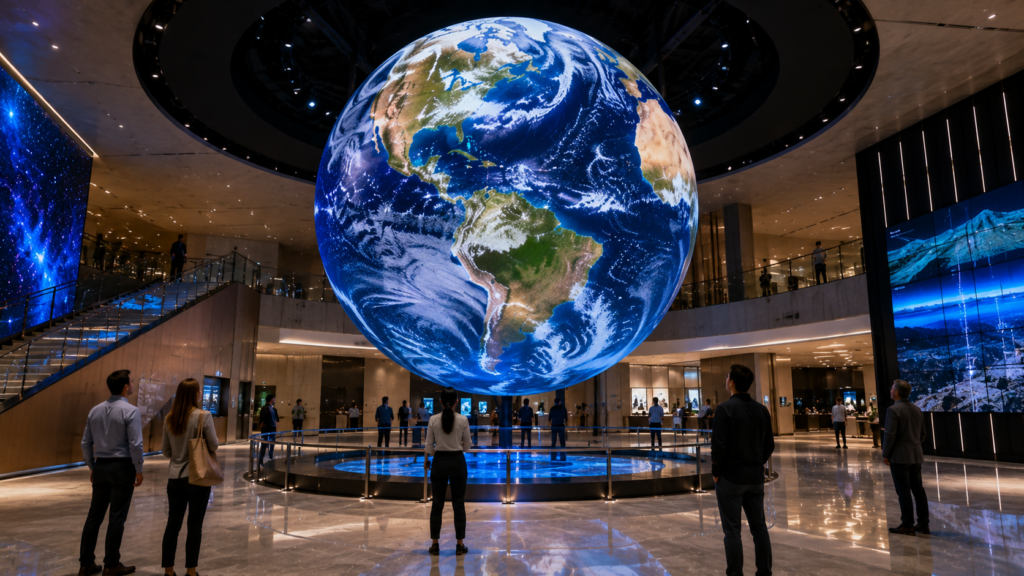
As businesses, museums, universities, and entertainment venues search for new ways to engage audiences, traditional flat-panel displays are becoming increasingly common. While video walls and digital signage continue to play important roles, many organizations now want display technologies that immediately stand out.
As a result, digital spheres have emerged as one of the most unique and visually engaging display solutions available today. Unlike conventional screens that limit viewing to a single direction, spherical displays allow content to be viewed from virtually every angle.
Consequently, they create experiences that attract attention, encourage interaction, and leave lasting impressions. Furthermore, because spherical content naturally mirrors many real-world subjects, these displays provide powerful visualization opportunities across a wide range of industries.
What Is a Digital Sphere?
A digital sphere is a spherical LED display capable of presenting content across a complete 360-degree surface.
Unlike flat displays, which restrict content to a rectangular format, spherical systems wrap imagery around an entire globe-shaped structure.
As a result, viewers can experience content from multiple perspectives while moving around the display.
Digital spheres are commonly used for:
- Museums
- Science centers
- Corporate lobbies
- Trade shows
- Airports
- Universities
- Visitor centers
- Retail environments
- Entertainment attractions
Additionally, digital spheres are available in various sizes, allowing organizations to create experiences that fit both small and large environments.
Why Spherical Displays Generate More Attention
People naturally notice objects that are different from their surroundings.
Because most digital displays are flat, a spherical display immediately creates visual curiosity.
Furthermore, content displayed on a globe-shaped surface feels more dynamic and immersive.
Key benefits include:
- 360-degree visibility
- Increased audience engagement
- Memorable visitor experiences
- Enhanced storytelling
- Strong social media appeal
- Architectural impact
- Unique content presentation
As a result, digital spheres often become the centerpiece of an environment rather than simply another display.
Digital Spheres for Museums
Museums have become one of the largest adopters of spherical display technology.
Because many educational subjects involve global or planetary concepts, spherical displays often provide a more intuitive viewing experience.
Popular applications include:
Earth Science Exhibits
Museums can display weather systems, climate patterns, ocean currents, and environmental changes across a realistic globe.
Astronomy Experiences
Visitors can explore planets, moons, stars, and celestial events in a highly engaging format.
Geographic Education
Global population trends, migration patterns, and international data become easier to understand when displayed on a sphere.
Consequently, visitors can better visualize complex concepts while improving educational retention.
Digital Spheres for Science Centers
Science centers frequently use spherical displays to make difficult topics easier to understand.
Because scientific information often involves movement and spatial relationships, traditional screens can limit visualization.
However, spherical displays provide a more natural way to present:
- Weather systems
- Climate models
- Planetary science
- Oceanography
- Geological processes
- Environmental research
Furthermore, visitors can observe information from multiple angles, which often improves understanding.
Digital Spheres for Corporate Lobbies
Corporate organizations increasingly use digital spheres to create memorable first impressions.
Because visitors immediately notice large spherical displays, they often become focal points within a lobby environment.
Applications include:
- Corporate storytelling
- Brand visualization
- Global operations maps
- Company milestones
- Real-time data displays
Additionally, spherical displays reinforce innovation and technological leadership.
As a result, businesses can communicate a modern brand image before conversations even begin.
Digital Spheres for Trade Shows
Trade show exhibitors constantly compete for attention.
Therefore, many organizations use digital spheres to attract attendees from across the exhibit floor.
Benefits include:
- Increased booth visibility
- Greater attendee engagement
- Improved lead generation
- Enhanced brand awareness
- Stronger social media exposure
Furthermore, because content remains visible from multiple directions, spherical displays can attract visitors regardless of where they are standing.
Consequently, exhibitors often gain more exposure than they would with traditional displays.
Digital Spheres for Airports and Public Spaces
Airports and transportation hubs require highly visible communication systems.
Because digital spheres can be viewed from long distances and multiple directions, they work exceptionally well in large public environments.
Applications include:
- Wayfinding
- Tourism promotion
- Public information
- Brand advertising
- Interactive experiences
Additionally, the unique shape helps distinguish important content from surrounding signage.
Content Possibilities for Spherical Displays
One of the greatest strengths of digital spheres is content flexibility.
Organizations can display:
- Earth visualizations
- Planetary content
- Sports graphics
- Corporate branding
- Data visualizations
- Interactive content
- Artistic animations
- Educational programming
Because content can change instantly, organizations can continually refresh the experience without modifying the physical display.
Therefore, digital spheres remain relevant long after installation.
Digital Spheres vs Traditional Displays
| Feature | Digital Sphere | Traditional Display |
|---|---|---|
| 360° Visibility | Excellent | Limited |
| Architectural Impact | High | Moderate |
| Audience Engagement | High | Moderate |
| Social Media Appeal | High | Moderate |
| Visualization Capability | Excellent | Good |
| Memorability | High | Moderate |
| Content Flexibility | High | High |
Although traditional displays remain valuable, spherical displays provide a level of uniqueness that few technologies can match.
As a result, organizations seeking maximum visual impact often choose spherical solutions.
Common Mistakes When Planning a Digital Sphere
Many organizations focus primarily on the hardware while overlooking content development.
Common mistakes include:
- Using flat-screen content
- Ignoring spherical formatting
- Underestimating content creation requirements
- Poor placement planning
- Insufficient viewing space
- Lack of content updates
Because content drives the experience, successful projects require both strong hardware and properly designed media.
Furthermore, organizations should plan for future content updates from the beginning.
Future Trends in Spherical Visualization
Digital sphere technology continues advancing rapidly.
Emerging trends include:
- Interactive content
- Real-time data visualization
- AI-driven content generation
- Touch integration
- Multi-display synchronization
- Immersive environment integration
Additionally, digital spheres increasingly work alongside LED walls, projection systems, interactive kiosks, and transparent OLED displays.
As a result, organizations can create complete immersive ecosystems rather than standalone installations.
FAQ
What is a digital sphere?
A digital sphere is a spherical LED display that presents content across a 360-degree surface.
Where are digital spheres commonly used?
Digital spheres are frequently used in museums, science centers, corporate lobbies, trade shows, airports, and visitor centers.
Can digital spheres display live data?
Yes. Many systems can display real-time information, dashboards, weather data, and custom visualizations.
What type of content works best?
Earth science, astronomy, global data, sports graphics, branding, and artistic visualizations work particularly well.
Why Choose Screen Solutions International
Screen Solutions International designs and supplies advanced digital sphere systems for organizations seeking unique visual experiences.
SSI solutions include:
- Indoor Digital Spheres
- Outdoor Digital Spheres
- Interactive Spherical Displays
- LED Video Walls
- Interactive Kiosks
- Transparent OLED Displays
- Projection Systems
- Custom Experiential Technologies
Additionally, SSI assists with display sizing, content strategy, installation planning, and long-term support. As a result, clients receive solutions optimized for engagement, performance, and reliability.
Final Takeaway
Digital spheres continue redefining how organizations communicate information and engage audiences. Because they provide 360-degree visibility, strong visual impact, and exceptional storytelling capabilities, they remain one of the most attention-grabbing display technologies available.
Ultimately, organizations that want to create memorable experiences should consider how spherical display technology can enhance visitor engagement. As immersive environments continue growing in popularity, digital spheres will remain at the forefront of experiential design.
Sources
Internal SSI Links
- https://ssidisplays.com/
- https://ssidisplays.com/digital-spheres/
- https://ssidisplays.com/led-video-walls/
- https://ssidisplays.com/interactive-kiosks/
External Authority Sources