
 Introduction
LED display technology has evolved significantly over the past decade. As a result, businesses now have more options than ever when selecting an LED video wall. However, one question consistently comes up during the buying process:
Should I choose a COB LED display or an SMD LED display?
Although both technologies deliver stunning visuals and exceptional performance, they are built differently. Consequently, they each offer unique advantages depending on the environment, viewing distance, maintenance requirements, and overall project goals.
Whether you’re installing an LED video wall in a corporate lobby, executive boardroom, control room, museum, retail space, broadcast studio, or command center, understanding the differences between COB and SMD technology will help you make a smarter investment.
At Screen Solutions International (SSI), we help organizations select the right LED technology based on real-world applications—not simply the newest or most expensive option. Instead, we evaluate your environment, audience, budget, and long-term objectives to recommend the best solution.
In this guide, you’ll learn how COB and SMD LED displays work, how they compare, and which technology is best suited for your project.
What Is an SMD LED Display?
SMD stands for Surface-Mounted Device.
For many years, SMD technology has been the industry standard for commercial LED video walls.
Each individual LED package contains three microscopic LEDs:
- Red
- Green
- Blue
Together, these LEDs create millions of colors while producing exceptional brightness and image quality.
Because manufacturers have refined SMD technology for decades, today’s premium SMD displays deliver outstanding performance across a wide variety of commercial applications.
Common SMD applications include:
- Corporate headquarters
- Executive boardrooms
- Retail environments
- Houses of worship
- Museums
- Universities
- Trade show exhibits
- Broadcast studios
- Hospitality venues
As a result, SMD remains one of the most versatile LED display technologies available today.
What Is a COB LED Display?
COB stands for Chip-on-Board.
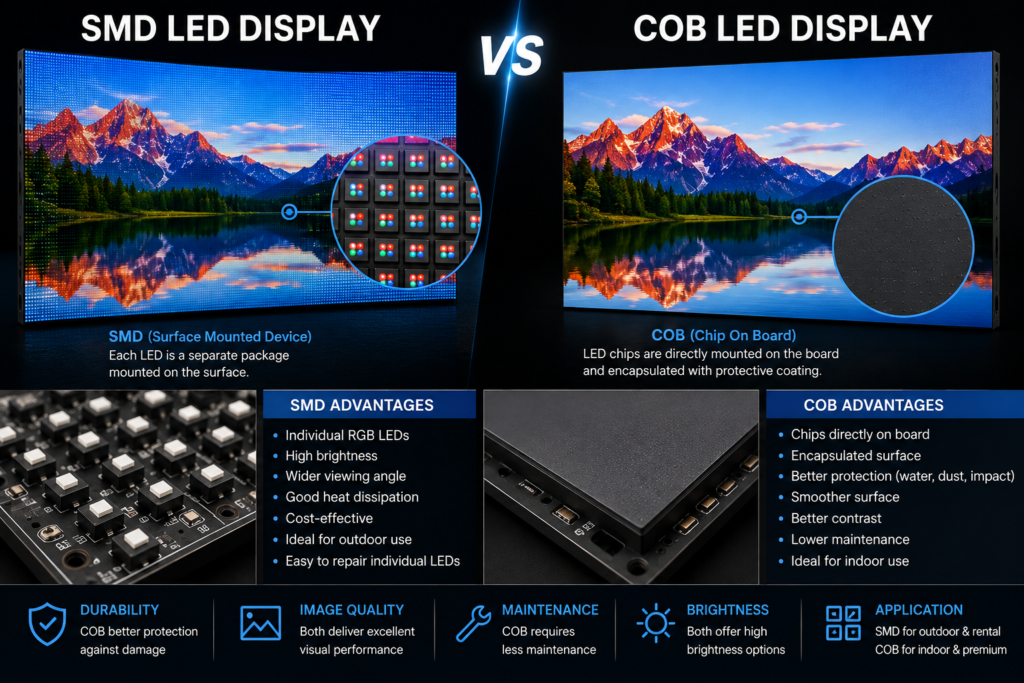
Unlike SMD displays, COB technology mounts multiple LED chips directly onto the circuit board before sealing them beneath a protective coating.
Consequently, the display surface becomes smoother, stronger, and more resistant to damage.
This manufacturing process provides several important benefits.
COB displays offer increased protection against:
- Dust
- Moisture
- Static electricity
- Accidental impacts
- Surface contamination
Furthermore, the protective coating creates a cleaner appearance while helping improve long-term durability.
Because of these characteristics, COB technology has become increasingly popular for high-end commercial installations and environments where reliability is especially important.
Understanding the Difference Between COB and SMD
Although both technologies create vibrant, high-quality images, their construction methods are very different.
With SMD technology, each LED package sits individually on the circuit board.
With COB technology, the LED chips are mounted directly to the board and then encapsulated beneath a protective layer.
As a result, COB displays have a more uniform display surface.
However, that doesn’t automatically make one technology better than the other.
Instead, each offers advantages depending on how and where the display will be used.
COB vs. SMD LED Displays
| Feature | COB LED | SMD LED |
|---|---|---|
| LED Construction | Chips mounted directly to board | Individual RGB LED packages |
| Surface Protection | Fully encapsulated | Individual LEDs exposed |
| Durability | Excellent | Very Good |
| Image Quality | Excellent | Excellent |
| Fine Pixel Pitch | Excellent | Excellent |
| Maintenance | Lower | Moderate |
| Brightness | Excellent | Excellent |
| Commercial Availability | Growing rapidly | Industry standard |
| Best For | High-touch environments | Most commercial applications |
Ultimately, both technologies produce exceptional images. Therefore, selecting the right one depends on your project requirements rather than marketing terminology.
Comparing Image Quality
One of the most common questions buyers ask is:
Which technology produces a better image?
The answer depends on the application.
Both COB and SMD displays provide:
- Rich color reproduction
- Excellent brightness
- High contrast ratios
- Wide viewing angles
- Smooth video playback
- High refresh rates
However, because COB displays have a smoother protective surface, many viewers perceive slightly improved image uniformity.
Additionally, COB technology may reduce glare in certain lighting conditions.
Meanwhile, premium SMD displays continue to produce outstanding image quality and remain the preferred solution for countless commercial installations worldwide.
Therefore, image quality alone should not determine your purchasing decision.
Which Technology Is More Durable?
Durability represents one of COB’s strongest advantages.
Because the LED chips are sealed beneath a protective coating, they are less vulnerable to accidental damage.
Consequently, COB displays perform exceptionally well in environments where visitors may come into contact with the screen.
Ideal COB applications include:
- Museums
- Visitor centers
- Education facilities
- Interactive exhibits
- Retail environments
- Experience centers
- Public venues
Meanwhile, SMD displays also provide excellent reliability when installed in controlled commercial environments.
For example, corporate boardrooms, conference centers, and executive lobbies often use SMD technology very successfully.
Therefore, durability requirements should influence your final decision.
Maintenance Requirements
Maintenance plays a significant role in total cost of ownership.
Fortunately, both technologies are designed for long operational life.
However, COB displays typically require less maintenance because their encapsulated surface protects the LEDs from dust and accidental contact.
Furthermore, cleaning the display surface is generally easier.
SMD displays remain highly reliable as well. Nevertheless, exposed LED packages require slightly more care in environments where physical contact is possible.
Consequently, organizations expecting heavy public interaction often choose COB technology.
Viewing Distance Still Matters
Many buyers assume that COB automatically means better image quality.
In reality, pixel pitch has a greater impact on image clarity than manufacturing technology.
For example:
P1.2–P1.5
Ideal for:
- Executive boardrooms
- Broadcast studios
- Control rooms
P1.5–P1.9
Excellent for:
- Corporate lobbies
- Museums
- Visitor centers
- Universities
P2.5
Ideal for:
- Retail
- Conference centers
- Trade show exhibits
Therefore, selecting the proper pixel pitch remains one of the most important decisions regardless of whether you choose COB or SMD.
If you’re new to pixel pitch, read our guide:
What Is Pixel Pitch? The Complete LED Video Wall Guide
Internal SSI Link:
https://ssidisplays.com/led-video-walls/
Best Applications for COB LED Displays
Because of their durability and protective surface, COB displays excel in demanding commercial environments.
Popular applications include:
- Interactive museums
- Government facilities
- Transportation hubs
- Healthcare environments
- Security operations centers
- Public visitor centers
- Experience centers
- Educational institutions
Furthermore, organizations expecting continuous operation often appreciate COB’s long-term reliability.
Best Applications for SMD LED Displays
SMD technology continues to dominate many commercial markets because it delivers exceptional performance across a broad range of applications.
Common installations include:
- Corporate headquarters
- Executive boardrooms
- Hotel lobbies
- Retail stores
- Churches
- Trade shows
- Entertainment venues
- Broadcast facilities
Consequently, SMD remains an excellent solution for businesses seeking premium image quality and proven performance.
Internal SSI Link:
https://ssidisplays.com/interactive-display-solutions/
Business Benefits and ROI
Whether you choose COB or SMD, LED displays provide measurable business value.
Stronger Brand Perception
Large-format LED displays immediately communicate innovation and professionalism.
As a result, visitors often develop stronger first impressions.
Improved Communication
High-resolution displays improve presentations, collaboration, and customer engagement.
Consequently, meetings become more productive and visual messaging becomes more impactful.
Long Operational Life
Commercial LED displays typically operate for approximately 100,000 hours.
Therefore, organizations enjoy years of dependable performance.
Flexible Content
Unlike printed signage, LED displays allow organizations to update messaging instantly.
As a result, marketing campaigns, business dashboards, and presentations remain current without replacing physical graphics.
Common Mistakes When Choosing Between COB and SMD
Assuming Newer Means Better
New technology isn’t always the best choice.
Instead, evaluate how the display will actually be used.
Ignoring the Environment
Humidity, dust, public interaction, and maintenance access all influence display performance.
Therefore, installation conditions should guide technology selection.
Choosing Based Only on Price
Initial purchase price represents only part of the investment.
Consequently, businesses should evaluate maintenance, lifespan, energy efficiency, and operational costs as well.
Forgetting About Future Expansion
Many organizations eventually expand their LED systems.
Therefore, future scalability should be considered during the initial design process.
Future Trends in COB and SMD LED Technology
LED technology continues advancing every year.
Several trends are shaping the future of commercial displays.
Smaller Pixel Pitches
Manufacturers continue reducing pixel spacing while increasing image quality.
Improved COB Manufacturing
Production efficiencies continue lowering costs and increasing availability.
Greater Energy Efficiency
Modern LED displays consume less power while producing brighter images.
AI-Based Calibration
Artificial intelligence increasingly automates brightness adjustment, color consistency, and system monitoring.
More Commercial Adoption
As prices continue becoming more competitive, both COB and fine-pitch SMD displays will appear in even more corporate environments.
Why Choose Screen Solutions International
Selecting between COB and SMD technology involves more than comparing specifications.
At Screen Solutions International, we help organizations identify the right solution based on viewing distance, environment, content requirements, operational goals, and long-term value.
SSI provides:
- Fine-Pitch LED Video Walls
- COB LED Displays
- SMD LED Displays
- Corporate Lobby Displays
- Executive Boardroom Displays
- Control Room Video Walls
- Interactive Displays
- High Bright Displays
- Digital Spheres
- Custom Experiential Display Solutions
Whether you’re designing a new headquarters, upgrading a command center, or creating an immersive visitor experience, SSI can design a complete LED solution tailored to your project.
Call 888-631-5880 to speak with an LED display specialist.
Frequently Asked Questions
Is COB better than SMD?
Not necessarily. COB offers greater durability, while SMD remains one of the most widely used and trusted LED technologies. The best choice depends on your application.
Is COB more expensive?
Historically, yes. However, manufacturing improvements continue making COB technology more affordable.
Which technology works best in a corporate lobby?
Both technologies perform exceptionally well. The ideal choice depends on visitor interaction, viewing distance, and budget.
Can COB and SMD both be used indoors?
Absolutely. Both technologies are widely used in commercial indoor environments.
How long do commercial LED displays last?
Most commercial-grade LED displays are rated for approximately 100,000 hours of operation with proper maintenance.
Final Takeaway
COB and SMD LED displays both deliver exceptional image quality, outstanding reliability, and long operational lifespans. However, choosing the right technology requires more than comparing specifications.
Instead, evaluate your viewing distance, installation environment, maintenance expectations, and business objectives. By selecting the technology that best fits your application, you’ll maximize image quality, reduce ownership costs, and create an LED display that continues delivering value for years to come.
If you’re planning a commercial LED project, the experts at Screen Solutions International can help you compare technologies, evaluate your space, and recommend the ideal solution. Contact 888-631-5880 today to start your project.
Sources
Internal SSI Sources
- https://ssidisplays.com/
- https://ssidisplays.com/led-video-walls/
- https://ssidisplays.com/interactive-display-solutions/
- https://ssidisplays.com/high-bright-displays/
- https://ssidisplays.com/contact-us/
External Authority Sources