Showing the single result
How LED Displays Transform Experiential Spaces
Introduction
Experiential spaces do more than show information. They create emotions. They tell stories. Most importantly, they leave lasting impressions.
Today, brands compete for attention everywhere. As a result, businesses need environments that people remember. Consequently, museums, corporate headquarters, visitor centers, entertainment venues, trade shows, and retail destinations are investing heavily in immersive experiences.
At the center of many of these environments sits one powerful technology: LED displays.
Unlike static signage, LED displays create movement, energy, and excitement. Furthermore, they can scale to virtually any size. As a result, designers can transform ordinary spaces into memorable destinations.
Whether you’re building a corporate experience center, designing a museum exhibit, creating a brand activation, or upgrading a public venue, LED displays can dramatically increase visitor engagement.
In this guide, we’ll explore how LED technology transforms experiential spaces and why more organizations are investing in immersive visual environments.
What Is an Experiential Space?
An experiential space is designed to engage visitors on multiple levels.
Rather than simply presenting information, these environments encourage interaction, exploration, and emotional connection.
Common examples include:
- Corporate lobbies
- Brand activation centers
- Museums
- Visitor centers
- Sports venues
- Entertainment attractions
- Retail flagship stores
- Innovation centers
- Trade show exhibits
Because these spaces focus on experience, visual technology often becomes a critical component.
Consequently, LED displays have become one of the most widely adopted technologies for experiential design.
Why LED Displays Work So Well in Experiential Environments
People naturally respond to movement, color, and scale.
Therefore, LED displays immediately attract attention.
Additionally, LED technology offers brightness levels that traditional displays cannot match. As a result, content remains vibrant even in bright environments.
Other advantages include:
- Large-scale installations
- Seamless visuals
- High brightness
- Flexible shapes
- Real-time content updates
- Long operating life
- Interactive capabilities
Furthermore, LED displays allow designers to integrate digital storytelling directly into architecture.
Instead of hanging screens on walls, organizations can build immersive environments around the technology itself.
Internal SSI Link:
https://ssidisplays.com/led-video-walls/
Large LED Video Walls Create Instant Impact
When visitors enter a space, they often look for a focal point.
Large LED video walls provide exactly that.
Because these displays can span entire walls, they immediately establish visual hierarchy within a space.
For example, a corporate headquarters might use a massive LED wall to display:
- Company milestones
- Global operations
- Sustainability initiatives
- Product showcases
- Customer success stories
Meanwhile, museums may use LED walls to create dynamic exhibits that evolve throughout the day.
Consequently, visitors spend more time engaging with content.
Furthermore, large-scale visuals often encourage social sharing, which can extend brand exposure far beyond the physical location.
Internal SSI Link:
https://ssidisplays.com/interactive-display-solutions/
Curved LED Displays Increase Immersion
Flat displays work well in many applications. However, curved LED displays create a completely different experience.
Because curved surfaces wrap content around visitors, they increase immersion.
As a result, viewers feel connected to the content rather than simply observing it.
Common applications include:
- Museum exhibits
- Experience centers
- Corporate briefing rooms
- Retail environments
- Entertainment attractions
Additionally, curved LED displays help eliminate visual boundaries. Consequently, storytelling becomes more engaging and memorable.
Custom LED Shapes Unlock Creative Freedom
Today’s experiential environments demand creativity.
Fortunately, LED technology offers nearly unlimited design flexibility.
Organizations can create:
- LED columns
- LED cubes
- Digital spheres
- Curved ribbons
- Architectural integrations
- Ceiling displays
- Interactive LED sculptures
Because custom LED displays become part of the architecture, they help create truly unique spaces.
As a result, brands can differentiate themselves from competitors while creating memorable visitor experiences.
Internal SSI Link:
https://ssidisplays.com/digital-spheres/
Interactive Experiences Drive Engagement
Visitors no longer want passive experiences.
Instead, they want interaction.
Therefore, many organizations combine LED displays with:
- Touch technology
- Motion sensors
- RFID systems
- Mobile integrations
- Gesture controls
- Live data feeds
As a result, visitors become active participants.
Furthermore, interactive experiences often increase dwell time and improve information retention.
For brands, this creates additional opportunities to communicate key messages and strengthen customer relationships.
Content Flexibility Delivers Long-Term Value
One of the biggest advantages of LED displays is content flexibility.
Traditional exhibits often require expensive redesigns when information changes.
LED displays solve that problem.
Organizations can update:
- Marketing campaigns
- Product launches
- Event messaging
- Live business data
- Seasonal content
- Interactive experiences
Consequently, spaces remain relevant without major physical modifications.
Furthermore, content teams can refresh experiences regularly while protecting long-term investments.
LED Displays vs Traditional Signage
| Feature | LED Displays | Traditional Signage |
|---|---|---|
| Dynamic Content | Excellent | None |
| Real-Time Updates | Yes | No |
| Visitor Engagement | Very High | Moderate |
| Interactive Features | Yes | No |
| Architectural Integration | Excellent | Limited |
| Long-Term Flexibility | Excellent | Limited |
| Experiential Impact | Exceptional | Moderate |
Therefore, organizations seeking immersive environments often choose LED technology over traditional alternatives.
Common Mistakes When Designing Experiential Spaces
Treating Displays as Afterthoughts
The most successful projects integrate LED technology early in the design process.
As a result, displays become part of the environment rather than additions to it.
Prioritizing Hardware Over Content
Even the best display cannot overcome weak content.
Therefore, organizations should invest in both technology and storytelling.
Ignoring Visitor Flow
Display placement matters.
Consequently, designers should consider how visitors move through a space.
Choosing Generic Experiences
Generic content rarely creates memorable moments.
Instead, organizations should develop experiences tailored to their audiences and objectives.
Future Trends in Experiential Display Design
Experiential environments continue to evolve rapidly.
Several technologies are shaping the future:
- AI-generated content
- Real-time personalization
- Interactive digital spheres
- Transparent OLED displays
- Motion-responsive environments
- Digital twin visualizations
- Data-driven storytelling
- Multi-surface LED ecosystems
Furthermore, organizations increasingly combine multiple display technologies into unified experiences.
As a result, future environments will become even more immersive.
Internal SSI Link:
https://ssidisplays.com/transparent-oled/
Why Choose Screen Solutions International
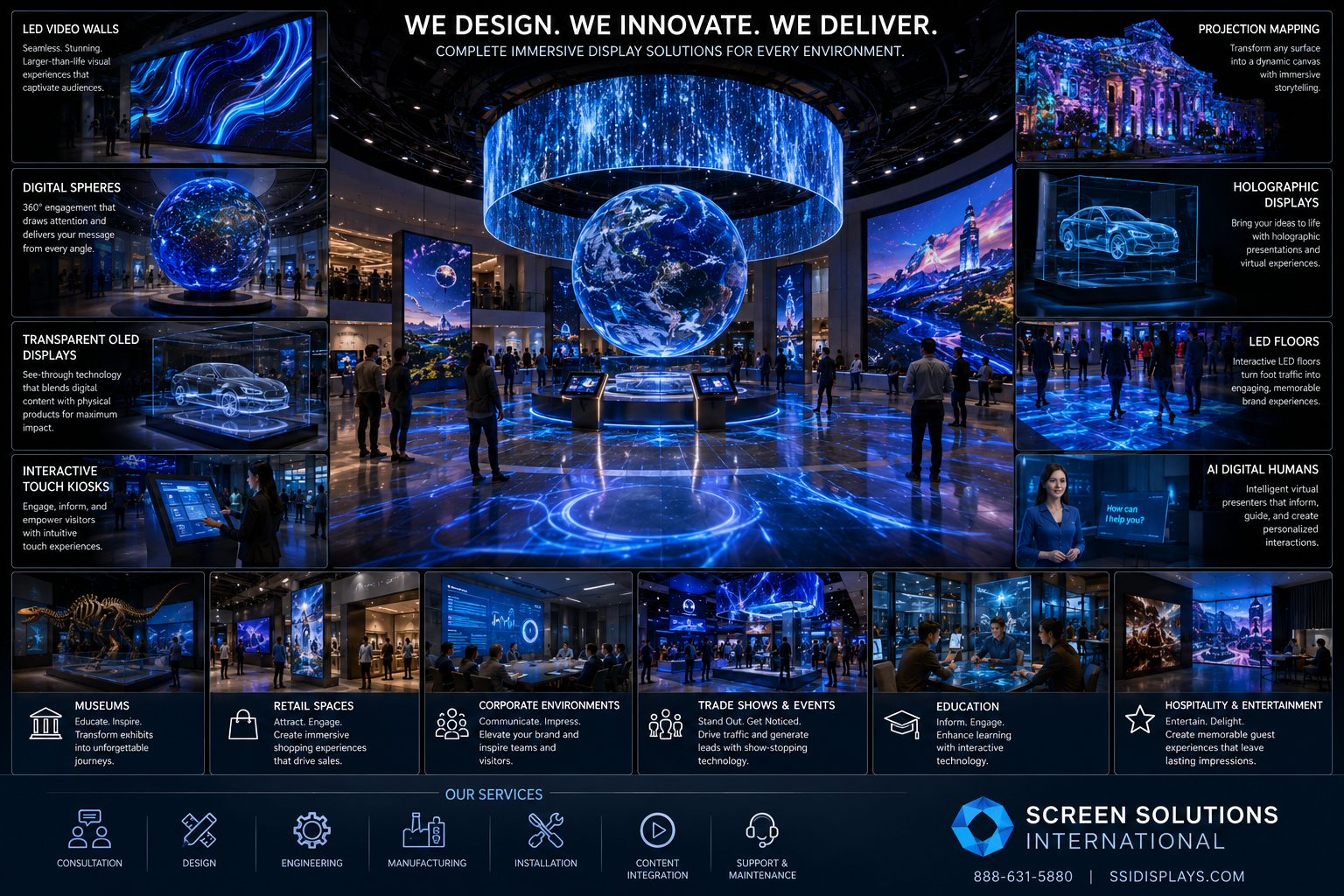
Screen Solutions International specializes in creating immersive display environments that help organizations engage audiences and communicate effectively.
SSI offers:
- LED Video Walls
- Digital Spheres
- Transparent OLED Displays
- Interactive Displays
- High Bright Displays
- Custom Experiential Displays
- Projection Systems
- Interactive Kiosks
Most importantly, SSI designs solutions around your goals, audience, and space.
Whether you’re building a corporate headquarters, museum exhibit, visitor center, or brand activation, SSI can help create an experience that delivers measurable results.
Call 888-631-5880 to discuss your project.
FAQ
What is an experiential display?
An experiential display combines visual technology, storytelling, and interaction to create engaging visitor experiences.
Why are LED displays popular in experiential spaces?
LED displays provide brightness, scale, flexibility, and immersive content capabilities that traditional signage cannot match.
Can LED displays be customized?
Yes. LED displays can be manufactured in custom shapes, sizes, curves, and architectural configurations.
Do experiential spaces increase visitor engagement?
Yes. Interactive and immersive environments often increase dwell time, information retention, and emotional connection.
Which industries use experiential LED displays?
Corporate, retail, hospitality, museums, entertainment, education, healthcare, and government organizations all use experiential display technology.
Final Takeaway
Experiential spaces succeed when they create emotional connections. Therefore, organizations must invest in technologies that support immersive storytelling and audience engagement.
LED displays provide the scale, flexibility, brightness, and creativity needed to build these experiences. Furthermore, custom LED solutions allow organizations to integrate technology directly into the architecture of a space.
As visitor expectations continue to evolve, experiential environments will become even more important. Consequently, organizations that invest in LED-powered experiences today position themselves for stronger engagement, better brand perception, and more memorable customer interactions tomorrow.
To learn more about custom experiential display solutions, contact Screen Solutions International at 888-631-5880.
Sources
Internal SSI Sources
- https://ssidisplays.com/
- https://ssidisplays.com/led-video-walls/
- https://ssidisplays.com/interactive-display-solutions/
- https://ssidisplays.com/digital-spheres/
- https://ssidisplays.com/transparent-oled/
- https://ssidisplays.com/contact-us/
External Authority Sources
Latest Post